Autor
Markus Limacher



Cyber risks in OT environments rarely manifest themselves as major incidents; they often only become apparent at critical moments. A near-incident from industrial practice illustrates how quickly stable operational processes can turn into a serious risk.
"Everything was running smoothly." This is probably how the situation at OT-Maschinenbau [name changed by the editor] would have been assessed. The long-established company produces on modern production lines in three-shift operation, the order intake is well filled and the processes are well-rehearsed. To the outside world, the company appears stable, controlled and resilient.
But then it (almost) happens! An attacker accesses a control system via insecure remote access for external service technicians. Fortunately, the security monitoring system sounds the alarm in good time, even before a potential production outage causes millions in damage.
"We have realized that IT security alone is not enough. Our machines need their own protection."
For critical infrastructures and energy suppliers, unauthorized access is particularly serious. Here, a failure not only jeopardizes the company, but also the security of supply.
Resilience in industry and critical infrastructures is not a purely technical issue, but a management task. More and more management teams are consciously deciding not to leave OT security to chance, but to manage it in a structured way. The starting point is a sober stocktaking together with experts.
A status quo should answer the following questions:
Which systems are connected to the network?
Where are there unsecured interfaces?
What risks threaten production and security of supply?
Based on this, an OT security program is created that is based on security hygiene, clear responsibilities and established processes instead of just closing isolated weak points.
Instead of individual measures, OT mechanical engineering relies on a clear roadmap based on ISA/IEC 62443, the leading standard for industrial cyber security.
The implementation focuses on three clearly prioritized measures:
Segmentation of production networks into clearly defined security zones.
Secure remote access only via controlled gateways.
Training of OT personnel and commitment of all service partners to clear security rules.
The systematic approach according to ISA/IEC 62443 creates a permanently sustainable level of security, resilience through structure instead of patchwork.
The following roadmap, which is based on the standard, shows how this approach can be implemented in practice: from the initial assessment to the continuous development of OT security.
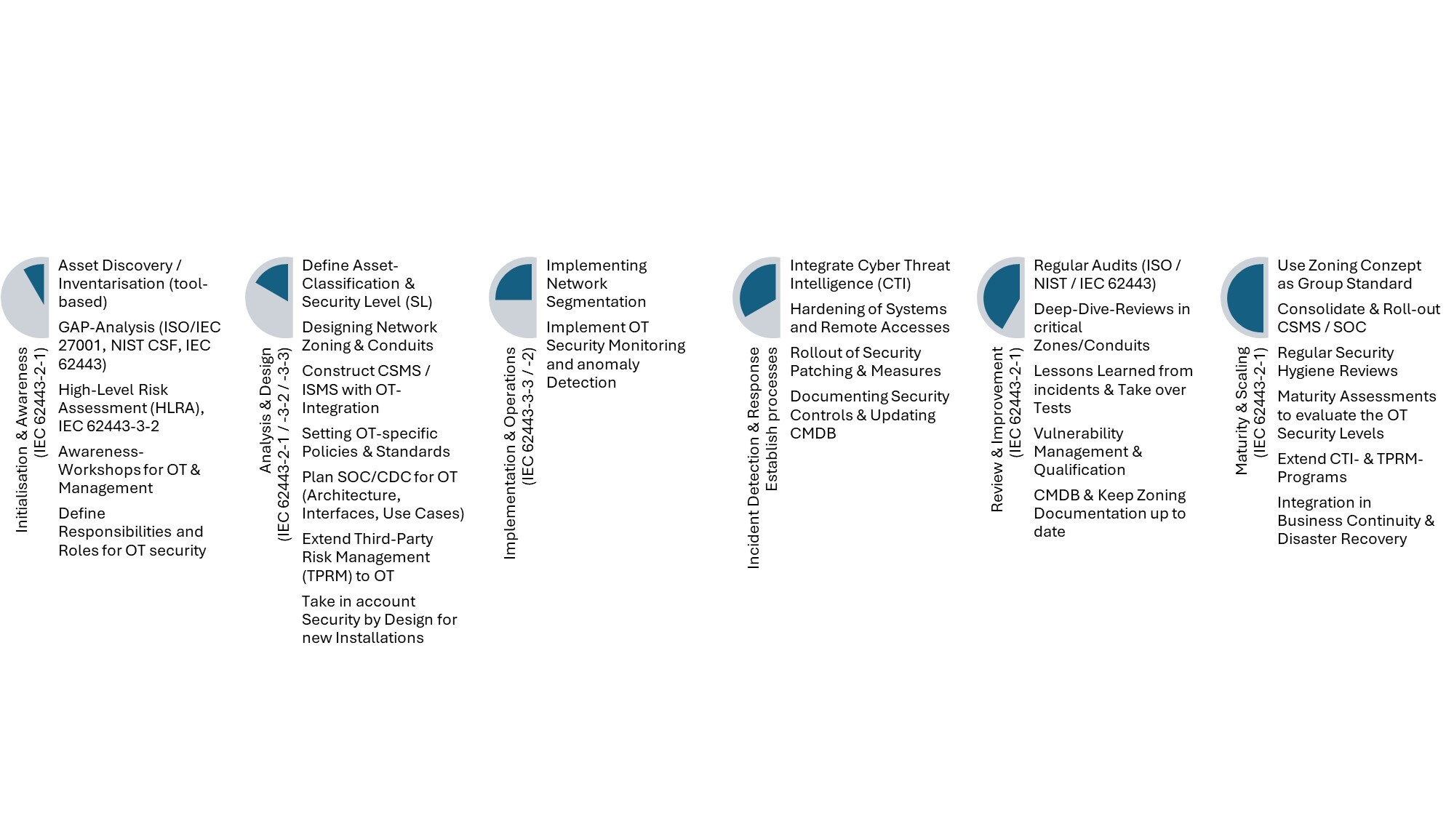 Figure: OT security journey according to ISA/IEC 62443
 Today, OT mechanical engineering has a robust level of security that not only reduces risks, but also makes them controllable. Security incidents are detected at an early stage, contained and dealt with in a traceable manner.
This level of security is based on three central operating principles:
More resilience: attacks can be fended off or quickly isolated.
Greater security: audits and third-party risk assessments are structured and regulatory requirements are reliably met.
Greater reliability: Customers, partners and authorities can see that the company works according to clearly defined and high standards.
OT security is therefore not a brake on business and production, but a prerequisite for faster processes and reliable decisions.
In industry and critical infrastructures, resilience is increasingly determining delivery capability, trust and competitive position. ISA/IEC 62443 provides a proven framework for establishing OT security as a continuous program - not a one-off project.
Those who act early,
fulfills regulatory requirements,
reduces the risk of operational interruptions and failures,
strengthens the trust of customers, partners and supervisory authorities.
Early action increases the maturity level of OT security. Companies that systematically build up industrial cyber security gain decisive room for maneuver in operations, vis-à-vis supervisory authorities and the market, and also vis-à-vis attackers in an emergency.
The InfoGuard OT Security Journey helps companies to plan OT security carefully and implement it effectively. The focus is not on individual measures, but on a resilient level of security for production and supply systems that proves itself in operation over the long term.
Precisely because cyberattacks on industrial environments are on the rise, practical experience shows that many successful incidents can be traced back less to a lack of technology than to inactive security functions, inadequately protected key components and a lack of operational anchoring of security processes.
A systematic OT security program ISA/IEC 62443 addresses precisely these weak points and thus not only protects machines and systems, but also secures the entire company's ability to act; in day-to-day operations as well as in an emergency. Speak to our experts about your next steps.

Caption: Image generated with AI